Sunday, August 22, 2010

OSU Jersey Scrimmage: Talkin' X's and O's...


I had the pleasure of watching the Ohio State jersey scrimmage yesterday with Bill Greene of ohiostate.scout.com.  Bill will have all kinds of good information regarding the offensive and defensive personnel and looks, but I wanted to extrapolate on five offensive schemes that stood out yesterday.  


1.  The Continued Expansion of the Rollout Play-Action Game

As I've previously touched on, OSU clearly wants to continue with the success they have had with the outside play action passing game, based off their patented inside run game.  The beauty, of course, is that it both constrains the defense and puts Terrelle Pryor on the edge where he is the biggest threat. 
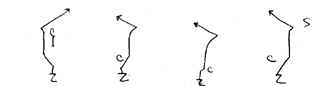
Ohio State is looking to build on this with the bootleg.  Yesterday's scrimmage featured numerious naked bootlegs off the inside zone fake from under center.   
The top-left hand diagram is essentially what you would see.  The fullback comes back to block backside and then releases into the flat.  The nice feature of this play is that it looks precisely like the inside zone action.  The pattern off of this was generally a weak flood:


Though this bootleg has long been an offensive staple for many teams, it has been relatively underutilized by OSU and  will be another successful way to both constrain defenses and take advantage of Pryor's abilities. 

2.  The Outside Toss

Another new edition to the play book looks to be an outside toss.  OSU ran this play from one-back '11'
formations to either a tight wing or trips' side.  One time they ran this into an unbalanced trips formation.  OSU blocked this as an outside zone play.  


The goal was to establish a seam through the wingback and TE getting outside leverage and hit it upfield quick.  Again another example of OSU trying to do more to get outside the tackle box. 


3.  Sprint Draw Series

Ohio State continued to expand on their use of the sprint draw run and play-action pass.  The OSU QBs and Oline did a very good job selling pass.  For instance, if they were running the sprint draw play to the left the QB would drop back and at the last moment reverse around and hand-off, rather than fronting out left after receiving the snap.  In one instance Pryor pumped faked a quick pass and then handed off, as has become so prevalent in the NFL.  The play was best on display on a 20 yard pass from Pryor to Stoneburner.  OSU ran the sprint draw pass with 3-verticals and Pryor hit Stoneburner on a perfectly timed cut where Stoneburner split the two deep safeties.  It again demonstrated the effectiveness of this play action pass at getting big plays out of the passing game.


4.  Shallow Crossing Routes

OSU also continues to expand on its horizontal dropback passing game by featuring a large number of shallow crossing routes.  Specifically, OSU repeatedly ran what is known as a 'drive' route in West Coast nomenclature.  Here, courtesy of 'Smart Football' is a diagram of the key two man route:       

  Essentially, the outside receiver runs a shallow cross while the inside receiver (or tight end) on the same side runs a shallow-in.  The QB can have several progressions, but my assumption based on what I saw yesterday is that the QB is reading shallow cross to square-in.  As Pryor progresses it is clear that OSU is more comfortable attacking the middle of the field.

5.  Unbalanced

The coaching staff also continues to use unbalanced looks to challenge a defense's soundess and keys.  In particular, as previously mentioned, OSU likes using the unbalanced twins I-look.  From this, one of OSU's favorite plays continues to be the fake sprint-draw to the lead side, then hit the FB on a quick weakside flat route.    


The play's simplicity belies it's effectiveness.  A defensive secondary is generally going to roll to the unbalanced twins side, leaving the backside corner back responsible for the weakside.  But the backside corner must deal with the most immediate threat, namely a releasing tight end.  This leaves the full back flooding into the flat with only the linebacker to cover that zone.  But that linebacker is held by the play fake, and generally a linebacker is subconsciously going to think run when he sees unbalanced.  The play is very effective for picking up yards and takes advantage of Zach Boren's talents as a receiver.  


In sum, OSU continues to expand on where they were at the end of last season, featuring the inside run game and play action and roll-outs off of those fakes, and a quick, horizontal drop back pass game.  The coaching staff is clearly continuing to expand the offenses possibilities with a veteran unit. 

Friday, August 13, 2010

The Ohio State Offensive Playbook Part II: The Sprint Draw Series

The second play grouping I want to cover is the sprint draw (also known as lead draw) and sprint draw play pass.  This play has long been a staple of pro-style offenses, but has been relatively under-utilized by Tressel's offenses, given the amount of I formation OSU has run.  However, the sprint draw and its accompanying play-action pass were more prevalent this spring and I expect it will likewise become a bigger part of the OSU arsenal this fall.  The reason is two-fold:  a) an offensive line well built to run-block this play; and b) as discussed below, the options the sprint draw play pass gives you in the passing game, particularly delivering the ball down the deep middle.


Sprint Draw

The Sprint Draw is traditionally a man or area blocking scheme, though it can be run with a zone scheme.  Below is a basic diagram of the play.  (Courtesy of Smart Football).    


And here from 'Husker Playbook':

Teams vary in how much they have their offensive line set for pass block, depending on how devoted they are to showing pass..  Here are the general line rules for the play from 'Shakin' the Southland':    

FST- Lead/base blocks End, could have help inside from the Guard (a "smash" call). If he slants (pinches inside to the center), then the tackle down blocks him. If he stays outside, the tackle may turn him out.
FSG-If covered, slides and base blocks the DT. If uncovered, he lead blocks the DE with the FST. If the Nose is shaded to his A-gap (1-tech), he will combo with the Center.
Center-If covered, takes the Nose Guard or Shade DT base. If uncovered, smash/combo blocks with the BSG on his man.
BSG-If covered, base. If uncovered, combo block with the Center on the Shade or Nose.
BST-Stays put, cuts off the backside pursuit.
 In so doing, the tackles are going to pass set, and allow the defensive ends to come upfield, letting the defenders' aggressiveness take them out of the play.  The key point is that on the playside defensive tackle, the two linemen are going to double and combo block through to the backside linebacker.  Against a 4-3 under, that will be the Guard-Center on the playside NG, against a 4-3 over, it will be the Guard-Tackle against the '3' technique.

As to the backs,

  • Although this is not always the case, the play is best when the fullback is assigned to ISO on the first inside LBer from the playside Guard over.  He is blocking this play just like a traditional ISO, taking the LBer head-on. 
  • The TB is going to take two shuffle steps, taking the ball as deep as possible.  He is then going to read the playside double-team through to the FB.  The TB's goal is to make the ISO'd LBer wrong no matter what by reading the FB's block and cutting off his backside.
  • The QB is going to open up (as opposed to Dave or ISO where he reverse pivots) showing pass.  He is then going to deliver the ball deep to the TB and set up to play-pass.
  The benefits of the play are multi-fold:

  • The sprint draw takes advantage of a strong, athletic offensive line that can control the line of scrimmage (See Cowboys, Dallas).
  • The play allows a tailback to get the ball deep to use his vision and cut based off the line's blocks.
  • From the I-formation, the play can be run to equal benefit to the strong or weak side.
  • Sprint Draw, as discussed below, is a perfect complement to the sprint-draw pass, which allows the QB to get a deep drop while providing the offensive line the benefit of the play fake, so that they do not have to hold their blocks on a 7-step drop. 
As noted, Ohio State ran this play more this spring than they did all last fall, previewing a play that will likely become a bigger part of the repertoire this year.

Sprint Draw Pass

Part of the reason for the sprint draw's increasing prevalence is the passing play it sets up.  The sprint draw pass was increasingly utilized by the Buckeyes last year and became more prevalent in spring.  This play-pass has also long been a pro-formation staple, perhaps most famously utilized in the college game by Steve Spurrier's 'fun 'n' gun' offense.    

The beauty of the play is that it looks identical to the sprint draw run and allows the QB to get a deep drop.  Yet it simultaneously holds the defensive front with the run fake, making the offensive line job's easier than with a 7-step drop back pass.  The offensive line blocks identically to the sprint draw play.  The backs also run sprint draw, with the QB again opening up, prominently extending the ball out for the ball fake, then pulling the ball away from the tailback and setting up to pass. 

Here, courtesy of JWinslow of ohiostate.scout.com's 'Ask the Insider's' is video from OSU's fall practice.  At the 1:48 mark one get's a good line-level view of OSU's line and backs running the sprint draw action (though it is a bit different since they are running this from an 'unbalanced set').  Note how the backside pass-sets while the frontside comes out aggressively run-blocking.  Pryor opens up and delivers the play-fake before throwing into the flat.


Spurrier utilized this play to run a WR read route where the playside receiver would run a curl vs. cover-3 and a post-corner route vs. cover-2.  Ohio State, however, has embraced this play for different reasons.  First and foremost, OSU is utilizing the sprint draw pass to run the 'three verticals' route.  Here is Smart Football with the play's basic description and design:

In this play, here diagrammed from a base Pro-Set, the outside receivers will run post-corner routes, and the inside receiver, Y, will run a "middle-read" route, or "adjustable-8". The running backs will control the undercoverage with a shoot and a swing route. The outside receivers and the middle receiver have simple keys to help them adjust their routes based on the coverage and the leverage the defenders are using against them.

 The play is particularly effective against cover 2, because it is impossible for the two deep safeties to account for the three deep receivers, giving the offense a 3 on 2 advantage and making this play a coverage beater. 

This key actor in this play is the middle receiver.  Here again from Smart Football:

The middle-read receiver will take the fastest vertical release he can. He does NOT want to get slowed by the second level players. He will get a pre-snap and a post-snap look at the middle of the field. If the middle of the field is open (MOFO - cover 2, 0) he will go for it. If it is closed (MOFC - 1, 3, 4) he will run a square-in route.


He will take the fastest release and push to a depth of 10-12. If he reads MOFO he will stick his outside foot and head for the nearest upright. He wants to catch the ball at 18-22 yards, and is expecting to get hit after he catches it.

If he reads MOFC he will plant hard at 10-12 and will stick his outside foot and make a 90 degree cut. If he reads zone he will try to make eye contact with the QB and find the window between the linebackers to catch the football. If he reads man he will burst and sprint away from his defender.

With this in mind, one can see why the Buckeyes are now utilizing this play--it takes advantage of  Jake Stoneburner's receiving talents.  Similar to what the Indianapolis Colts like to do, Ohio State can hold the linebackers and safeties with the sprint draw fake and then hit Stoneburner on the skinny post.  OSU ran this play repeatedly during the Spring Game with Pryor throwing to Stoneburner.  In particular, this play caught my attention then:
Building on this, the most promising thing I saw in the Spring Game was a Pryor to Stoneburner connection on the 3-verticals route.  The defense was playing a cover-2 man under.  As described in the above article, Stoneburner read the cover 2 and broke to the post.  Pryor read this perfectly, stepped up into the pocket, and delivered a strike before Stoneburner broke on his cut.  It was very well executed and bodes well for OSU this year.
 The Sprint Draw 3-verticals pass play also gives OSU the ability to give the defense an unbalanced look and run the play virtually unchanged, as can be seen above in the fall practice clip.  A defense seeing an unbalanced look with naturally think run play, and the run fake will only further underscore that belief.  For the offense, the WR responsibilities are simply altered, with the inside receiver to the unbalanced twins side becoming the middle WR.  Below you can see this play against PSU and how PSU's safeties were held in place by the run fake.


Tressel and company have done a nice job recently mixing unbalanced looks with more 'open' spread and pro-style concepts, confusing defenses who are thinking run first.  This trend will likely continue this fall. 


Monday, August 9, 2010

2010 Ohio State Offense: Dave Update

Here is a great additional resource for the Dave play:  a copy of the 2002 OSU playbook.  Though outdated in some respects, the Dave diagram and rules hold as true today.  The playbook gives the rules for each position and diagrams the play against nearly every possible defensive combination.  Well-worth the read.

One will note, however, that this playbook does not contain the Dave rollout keep or play-pass, demonstrating how these were a nice adaptation by the coaching staff last fall.   

Saturday, August 7, 2010

The 2010 Ohio State Playbook Part I: The 'Dave Series'


Based on my observations from last year and this spring what follows below is a discussion of the main plays that will likely constitute the 2010 Ohio State offense.  This list is not comprehensive but is instead what I would consider some of the Ohio State offense's "base plays." This post is a follow-up to my preview article in Buckeye Battle Cry.  There, I discuss the schematic framework the 2010 Buckeyes will likely bring to the table.  Here, I look at some of the underlying plays that Ohio State will run.  I will begin with the run plays and corresponding pass plays, and then preview some of Ohio State's primary pass patterns.  Part I will begin by looking at the 'Dave Series.'


 RUN GAME

The Dave Series

Power (Dave) Play 

Any discussion of the Ohio State run game under Tressel must start with the ubiquitous 'Dave' play (ofter referred to as the power-play in general nomenclature).  Tressel is not alone in favoring this play--it is generally considered the most popular run play in modern football.  Tressel discussed the play in detail at a coaching clinic, but the basics (courtesy of Chris Brown) are as follows:

  • The lineman to the side the run is going (playside) essentially “down” block, meaning they take the man to the inside of them. For the guards and center, that includes anyone “heads up” or covering them, but for the playside tackle, he does not want to block the defensive end or other “end man on the line of scrimmage.” These lineman use their leverage to get good angles to crush the defensive lineman, and the fact that they don’t have to block a couple of defenders on the playside frees them to get good double teams and block the backside linebackers. To use Vince Lombardi’s phrase, the idea is to get so much force going that direction that they completely seal off the backside.
  • They can  do this because they get some help to the playside. First, the fullback (or, more often nowadays, some kind of H-back or other player) is responsible for blocking the otherwise unblocked end man on the line of scrimmage (“EMLOS”). He uses a “kick out” technique, simply meaning he blocks him from the inside to out, in order to create Lombardi’s famous “seal” going the other way.
  • The final piece of the puzzle is the backside guard (sometimes nowadays a tackle). He pulls and “leads,” meaning he retreats, looks first for the fullback’s block to cut off of, and then heads into the crease looking to block the first defender that shows up — typically the playside linebacker. He can block him whatever direction is best; it’s the runningback’s job to find the open lane.
  • The runner takes a lateral or slight delay step, takes the handoff from the quarterback, and follow’s the pulling guard’s block. As stated above, he wants to cut off that man’s block and get vertical quickly. It is a power play so he has to be willing to hit the hole fast; it’s not as much of a “read the defense” run as are zone runs, though it is a good complement to it.
 Here is a basic draw-up of the play


 OSU will run Dave from some variation of the I formation or from their "tight bunch" set where they have 3 TE/FBs bunch tight to the formation's strength (see below):


OSU can run this play either to the strong or weakside--though practically its more difficult to run weakside because they angles are so tight.  The play also lends itself to better angles against a 4-3 over rather than a 4-3 under, because of the difficult back block the center has against the backside 3 tackle  (see the top left diagram above).

The downside of this play (which I have previously discussed) is that all the action is front-side so that OSU can find itself in a situation where back-side penetration breaks down the play.  But OSU has taken steps to make Dave a more dangerous play, as discussed below.


Dave Rollout Designed Run

As mentioned in my Buckeye Battle Cry article,  Ohio State in 2009 developed a nice package to take advantage of the initial Dave action.   Interestingly, Ohio State did not develop a series that attacked the backside pressure, but instead choose to further attack the front-side of the play action and put the force players in a bind.  The first play they used to do this is a called fake Dave QB roll-out keep.  This is actually an old play that T-formation teams used to run that OSU has successfully revitalized.  OSU ate up chunks of yards calling this play against Oregon on the final drive.


This play looks exactly the same as Dave:

  • The offensive line to the front side is going to run the exact same play.  Everyone through to the Center is going to down block to the inside gap.  
  • The FB is going to again attack the EMOLS.  As you can see watching the above play, however, the FB is going to try to 'influence' the OLB or DE to 'wrong arm' him like the defender is taught to do against the Dave play.  The FB will then hook up and box him in if successful.  
  • The backside guard is going to again pull, but this time rather than lead up inside the FB's kick-out block, he is going to pull around the FB and lead up on the outside 'force' player.  
  • The QB is going to fake Dave and then get depth and run a sweep, following the backside Guard's block.
One can instantly see the bind this puts on the outside defensive players.  As noted, the OLB or DE is taught to come in hard when they see the TE down-blocking to clog the C-gap.  But this play takes advantage of this aggressiveness by using the natural outside D gap that the defender is responsible for.  Oregon's players came down hard on the Dave action, leaving a wide outside gap.  It also puts the force player (the safety or corner) in a bind because they must think pass with the QB rolling out.  Of course, it helps to have a QB that runs a 4.3 and that naturally wants to find the edge against the defense.


Dave Rollout Pass


The final play that encompasses this series is the rollout pass off of the Dave play fake.  This play looks identical to the Dave rollout-QB keep except that the pulling guard is not going to go downfield.  Instead he is going to settle down outside the down blocks to create the pocket for the QB.  And the QB is going to get more depth than he would when running the designed run so that he will have room to set his feet and step into the throw.

OSU likes running this fake into a 'twins' set, meaning two wide receivers to the same side.  The base pattern they run off of this is a smash route.

 
This is one of the more popular route combination in college football, particularly against cover-2.  As one can see, it puts the cover-2 squat corner back in the disadvantageous position of having to cover a hi and low pattern, giving the offense a 2 on 1 advantage.   

Ohio State also likes taking advantage of the 'switch' concept to the two receiver side.  Originally a run 'n' shoot concept, the switch, as Chris Brown describes:

Is, at core, a two man concept. Two receivers release and "switch": The outside guys angle inside for 5-6 yards before pushing vertical, while the inside guy runs a "wheel route" under the outside guy, rubs right off of his hip, and then turns up the sideline. That's when they play gets interesting. 
 Finally, OSU will run essentially a variant of the smash where the inside receiver (normally Sanzenbacher) will run an out route and the inside receiver (Posey) will run a post-corner route.  This combination led to the majority of OSU's big plays out of the pass game last year.


As noted, the play puts the front side defensive backs in a bind.  Not only is it an effective pass combination against cover-2 or man, but the defensive backs must also contend with the run threat from Pryor, exacerbated by the called run play.

Tressel and company have therefore figured out a way to take their favorite run play--Dave--and make it far more effective by adding the run-pass edge threat that Terrelle Pryor presents.  Expect these plays to again be a large part of the 2010 offense.

Wednesday, July 14, 2010

Maple Street Press Preview Out

I'm giving myself a shameless plug and promoting the Maple Street Press' 'Buckeye Battle Cry,' their annual in-depth preview for the 2010 Buckeye season. 


I was fortunate enough to have an opportunity to write an article for the preview edition, titled "Meeting of the Minds: Jim Tressel, Terrelle Pryor, and the 2010 Ohio State Offense."  The article previews the 2010 offensive scheme by reviewing the up's and down's of the 2009 season schematically, through the hodge-podge scheme against USC, to the attempt to run a "spread-to-run" offense against Purdue, and then culminating in the Oregon victory.  I focus on what made OSU so successful against Oregon, namely adopting two 'series' based schemes built around the combined threat of the OSU inside run game and the pass/run threat Terrelle Pryor presents on the edge.  I expect we will see more of this to come in 2010.  But if you want to check out the full article I highly recommend picking up the magazine--lots of great stuff for the 2010 season!

My next project is--building on this article and after reviewing the spring game--is to lay out the primary plays that make up the Buckeyes' offense.  

Tuesday, April 27, 2010

Spring Game Thoughts

I am going to focus in this post on my Spring Game analysis.  But in a follow-up post I am going to expand and focus specifically on what is the Ohio State 'base' offense heading into 2010, both in terms of overall philosophy and specific plays.  After watching this spring it is clear that Ohio State is building very specifically on the offense employed in the Oregon game going forward, which I will discuss in more detail in future posts.

But first, specific thoughts from the Spring Game.  I re-watched and broke down the first half and did a play-by-play for the First Quarter.  Here are my specific thoughts:

  • I will discuss this in more detail later, but it is suffice to say that Ohio State's downfield passing game has 'evolved' to transition from a more pro-style, downfield passing game, to what I would consider is a more-typical college based spread attack employed by teams like Texas and Oklahoma State.  (See here).  The focus of this is short, horizontal stretching routes, specifically the: all curl route; the double slant/snag combination; quick outs; and the double scat routes.  (The play action passing game is more vertical, namely with flag/out combo, switch, and post/dig).  OSU will then run a deeper horizontal stretch with the 3-verticals route.  I do not want to use the word 'revolution', but this represents a continued development of what OSU gradually included last year that peaked in the Oregon game.
  • Building on this, the most promising thing I saw in the Spring Game was a Pryor to Stoneburner connection on the 3-verticals route.  The defense was playing a cover-2 man under.  As described in the above article, Stoneburner read the cover 2 and broke to the post.  Pryor read this perfectly, stepped up into the pocket, and delivered a strike before Stoneburner broke on his cut.  It was very well executed and bodes well for OSU this year.
  • I am with those who think Stoneburner is legit.  He needs to improve his 'scramble' reactions when the QB starts moving.  But he is a threat down the seams and the deep corner and brings another dimension that allows OSU to expand their pass game in the way described above.
  • Adams has, in my mind, locked down the LT position.  He is doing a great job sitting down in pass protection, being patient, and using his feet.  Last year he would get in trouble because he would rush to get outside, and then the DE would beat him underneath.  I am not seeing that any more.  I also think Marcus Hall may need to move inside.  He was constantly getting beat around the edge, and to me does not look to have the 'body' of a tackle.  It may simply be youth, but I would like to see him perhaps move inside with Adams and Shugarts only juniors.
  • Boom Herron ran the best I have seen him run as a Buckeye.  He stayed patient, kept his feet moving, and used his vision to find the hole as opposed to barreling into his blockers.  He was also the quickest I've seen him.  Jordan Hall again impressed me.  He had a great cutback on the first carry he received, which again makes me believe that he has the best vision of any of the running backs.
  • The Defense played very vanilla up-front.  They employed their usual array of coverages, but there was very little blitzing.  This gave the QBs more time and exposed the secondary more-so than they may otherwise be.
  • The above may qualify what I say here.  But I am now a bit concerned with the safety play.  I thought the safeties were repeatedly out of position and getting beat deep because they are too flat in their breaks.  I am not ready to pull the alarm yet because some of this were problems with the back-ups; I need to see Hines and Johnson together.  But I do not think there is any doubt that OSU's defensive strength is in the front 9, and I expect you will see defensive schemes that reflect it.
These are some quick thoughts, as I mentioned I will have an in-depth breakdown of OSU's offensive playbook coming soon.  For those interested, here is a play-by-play breakdown of the First Quarter +

First  Scarlet Series:
1st-10:  I sprint draw fake, 3 verticals.  Hall beat around right side, Pryor had to throw short
2d-10:  Gun ace right-Good time, nice job by Adams sitting down and moving his feet.  All curl play, Pryor anticipated Stoney’s cut and hit him right in stride.  5 yd gain.
3d-5:  Gun 4 wide.  Nickel.  2 high.  Rolle comes A gap.  Cover 1-robber.  Double snag routes.  Rolle beats Lindsey, Pryor doesn’t step into the throw and skips the in-route.

First Gray series
1st-10:  Gun split left.  4-3 under.  1 high.  Lead zone left.  Z Boren neutralizes Klein and Boom has a nice cut outside.  5 yd.
2d-5:  I-twins right.  4-3 over plus 2-high.  Sprint draw play pass right.  Cover 1 man.  Deep safety stays inside, Posey beats Torrence, PI.
1st-10:  Gun ace right strong.  3-4 heads up.  2 high.  3 man pass dropback route.  Q-Q-H coverage.   The DBs took false steps, wide open but Guiton didn’t put air under it. 
2d-10:  I right.  3-4 straight up.  Sprint draw right.  Offside.
2d-5:  I left.  4-3 over.  2 high.  Zip motion right to twins.  Sprint draw right.  Saine missed the cutback, instead tried to cut outside. 
3d-7:  Gun ace right strong..  Nickel double eagle 2 high.  Nickel blitz.  Double slant/snag route combo made so famous during Oregon.  Way too much DB slack in man coverage, easy pickings on the slant-route. 
1st-10:  Gun ace tight trips strong.  3-4 nickel.   4 vertical pass pattern.  Cover 3, Torrence never gets deep enough-nice catch by Washington.  Deep safety No. 8 got stuck in no mans-land.  Bad safety play for Scarlet.

Second Scarlet Series:
1st-10:  Gun tight trips left.  Nickel 2 high.  Cover 2 man under.  3 verticals.  Great read by Stoney on the 3 verticals play.  He saw the cover 2 so broke for the goal post between them.  Fantastic job by Pryor stepping up in the pocket, never taking his eyes off downfield and hitting him on the cut.  Most promising thing I’ve seen. 
1st-10:  I twins left.  4-3 open plus 2 high.  Fake Dave pass left.  LBers bit the Dave fake.  Very nice job by Browning getting his shoulders squared pulling.  Nice change up in the route—ran a ‘switch’ route.  Will fool teams expecting the flag-out combo.  Fooled Sabino who was stuck in no-mans land. 
1st-10:  Gun tight trips right weak.  4-3 under 2 high.  3 step ‘Texas double out route.”  Great job by Pryor
1st-10:  Gun tight trips left strong.  4-3 open plus 2 high.  Dropback.  Q-Q-H coverage.  Snag-flag combo.  Clarke got stuck in quick sand.  Pryor hit his spot and threw it right on time. 

Second Gray Series
1st-10:  Ace double tight wing right.  3-4 shaded to the field (NG and backside in 2-I techniques).  2 high.  Draw.  Great job by Brewster and Boren controlling and turning their men.  4 yds. 
2d-7: Gun 4 wide right.  4-2 nickel 2 high.  For whatever reason Mewhert did not get off on the snap count, leaving Bellamy basically untouched into the backfield.  Sack. 
3d-11:  Gun split backs left.  Nickel 1 high.  Q-Q-H.  Flood route left.  Miller got out of position and Heyward was able to shed inside.
Third Red Series
1st-10:  Strong I right.  4-2 nickel.  Playaction  shallow cross “drive” route.  M. Hall again got beat to the outside.  Pryor ball batted. 
2d-10:  Gun 4-wide.  Nickel 2 high.  Double snag route.  Hall got beat inside this time but Pryor stepped up and delievered the flag route.  Q-Q-H coverage but the deep half safety never got over to his side quickly.  Stoney in the slot running the flag route-tough in that position.  Great job with Adams dealing with the swin move.
1st-10:  Gun ace left.  4-3 over 1 high.  Double curl-flag route. 
2d-7:  Gun tight trips stron.  3-3 nickel.  4 verticals route.  2 deep man under.  Pryor throws the vertical to Stoney but doesn’t put enough air on it.  Should have checked down. 
3d-12:  Ace right:  3-3 nickel.  Adams overextended himself, getting beat inside quickly, forcing Pryor to dump off.  

Third Scarlet Series
1st-10:  Lead draw-great quicks by Boom; best I have seen him run

Saturday, April 17, 2010

The OSU 2010 Jersey Scrimmage

I had the privilege of attending the OSU jersey scrimmage today.  Because I was in the South Stands I had a good "video" view of the offensive and defensive schemes from directly behind the action.

I want to make one general point, then I'll turn to schemes and players.

Overall:  I'm sure the CW out of this scrimmage will be that the offense and offensive line were not any good.  But that is really an unfair reading.  First off, the 1s did not play very much as a unit.  And then of the snaps the 1s played, Pryor only played about half of those snaps.  I personally saw Pryor play maybe 3 series.  And then you have the fact that he is in a black jersey and cannot run.  And then you add the fact that the 1s were largely working situations, like coming out of their own goal line.  But all that being said, the first team offense largely did the job against the first team defense.  They moved the ball running, Pryor had time to make plays, and the line worked pretty well together.  There were some dropped balls, but the wind was terrible.  The one's looked worse when Bauserman played, as he cannot help but get balls tipped.  But where the offense really looked bad was the 2s and 3s against OSU's 2d and 3d string defense.  But think about it--we are so loaded at DE and LBer how many of those guys would be starting for every other Big Ten Team:  Wells, Thomas, Klein, Dorian Bell, Newsome, etc.  So they were lighting up patchwork second and third team O-Lines.  So you really can only expect so much.

Schemes:

Offense:

  • The offense is largely building upon what they did against Oregon.  It is a really nice package built around several series from both the shotgun and I that have the common theme of being built around the inside running threat and outside run/pass threat of Pryor.
  • That means a combination of the 'spread', namely with tight trips or 3 wide, split backs, based around the zone read play and then the half roll passes off of that, and then the I-formation, based upon the Dave/rollout and sprint draw series.  You will notice that all of these series have the common fact that they combine our inside running game with the outside run/pass threat bind that Pryor puts defenses in.  So it plays to the teams strengths and really works well together.  They all allow Pryor to get to the outside where he is such a threat.  For example, we saw the fake Dave QB run play that Pryor just killed Oregon.  That play puts the OLB in such a bind--does he screw down on the power play like he's taught to do, or does he stay outside to contain Pryor?  As VB said, pretty much all you can do is tell your SAM LBer to just make a decision one way or another, don't get stuck in no-man's land.  The Tight-trips shotgun formation also is such a threat to the defense.  They put the HB to the tight trips side.  That means you have 7 defenders to the strong side of the football that the defense has to acount for accordingly.  But then, OSU can run inside zone back to the weakside, and also has Posey alone to that side.  So a defense is put in the bind of both having to respect the numbers to the strength but accounting for what they may see to the weak side.
  • OSU is consciously working hard to get the TEs and Running Backs involved in the passing game.  OSU showed some unbalanced where Stoneburner would be to the weakside but then release into the pass route.  Every pass pattern called was a 5 man route with the TE running seam, drag, or in routes.

Defense
  • OSU's defense has reached a point that they are all so comfortable with teh system and what they are trying to do that they are getting very complicated.  Their base is 4-3 under personnel.  But from that they go a variety of ways.  Oftentimes they will play a 3-4, but they bump down one side into an 'eagle' look with a 3 technique.  The thing is, its really hard to figure out what their keys are.  Sometimes they bump the eagle down based on formation strength, sometimes based on the field.  Other times they played a straight-up 3-4.  Still other times they showed a 4-3 over.  Coverage-wise they are showing cover 1 press, but then often dropping to a lot of quarter-quarter-half coverage.
  • And the Defense was really bringing the heat today.  Rolle and Homan were constantly x-blitzing, and they would often bring Williams around on a twist.  Everything OSU is doing defensively reflects a staff and team that is confident in what they are doing and their ability.

Personnel
  • In the limited amount of action Pryor looked very comfortable in the pocket.  He was stepping up, making his reads, and staying comfortable in the pocket.  I remarked that he just looks much more comfortable and in control with everything.
  • Cameron Hayward is the leader of this team.  He is extremely vocal the first one running down the field to participate in drills, the one in front cheering and hollering on the defense, and spurring people on.  The defense takes on his persona and they were really animated and cheering each other on all day.  IIt is funny, Simon is like Heyward's shadow, he tries to follow and mimic everything he is doing.   The offense, by comparison, was pretty lacking in emotion.  Now, part of this is just the defense between offensive and defensive football.  But right now it is clear who the defense's leader is, the offense does not have someone as vocal.  Heyward is poised to take another step forward and be the most dominant defensive linemen in college fb this year.
  • The defense flies to the football.  It's hard to say certain people stand out, because they are running and gang-tackling everyone.
  • As I said, I thought the first team O-Line looked pretty good.  I thought Miller may have gotten a few more snaps than Adams, but I thought Adams more than held his own.  My personal sense is that Adams will be the starter and is playing better, but they are going to make him earn it.
  • I think Sabino has fully locked down the SAM spot.  People need to realize that the 3 LBer positions are not interchangeable.  You can play either the inside spots (Mike or Will) or the Sam spot.  The Sam is now always on the LOS and is basically a mix between your traditional head-up on the TE linebacker and the nickel star player.  Half the time he is playing in the "grey" area splitting between the end of the line and wide receivers, forcing everything inside.  Sabino's athleticism allows him to do this and really gives the 3-4 look another dimension.

Followers